Welcome back to my fourth blog about my class, Biorenewable resources. For this essay, I will be focusing on products derived from herbaceous biomass, or in other words, products made from plants that have a non-woody stem. I will first discuss how to extract sugar from starchy and lignocellulosic biomass, then converting those sugars into desired products, and finally some of the products we could make.
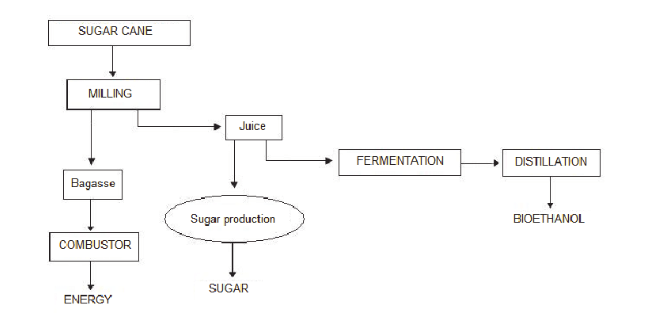
Before We get into what bioproducts we could make form the sugar, we need to know how to first extract the sugar. The sugar we use to make bioproducts first comes from various plant material, which includes things like sugarcane, corn kernels, and corn stover. Let’s take sugarcane for example. Sugarcane is first cut into several pieces, the leaves, tops, and stalk. The tops and leaves are burned or left in the field, while the stalk is brought to a sugar mill. IN the sugar mill, the stalk is cut and then washed in hot water to produce a sugar-rich juice. This juice is filtered and then evaporated until sugar and molasses are leftover. The sugar and molasses can finally be converted into things like biofuel or bioproducts. Below is a chart of this process.
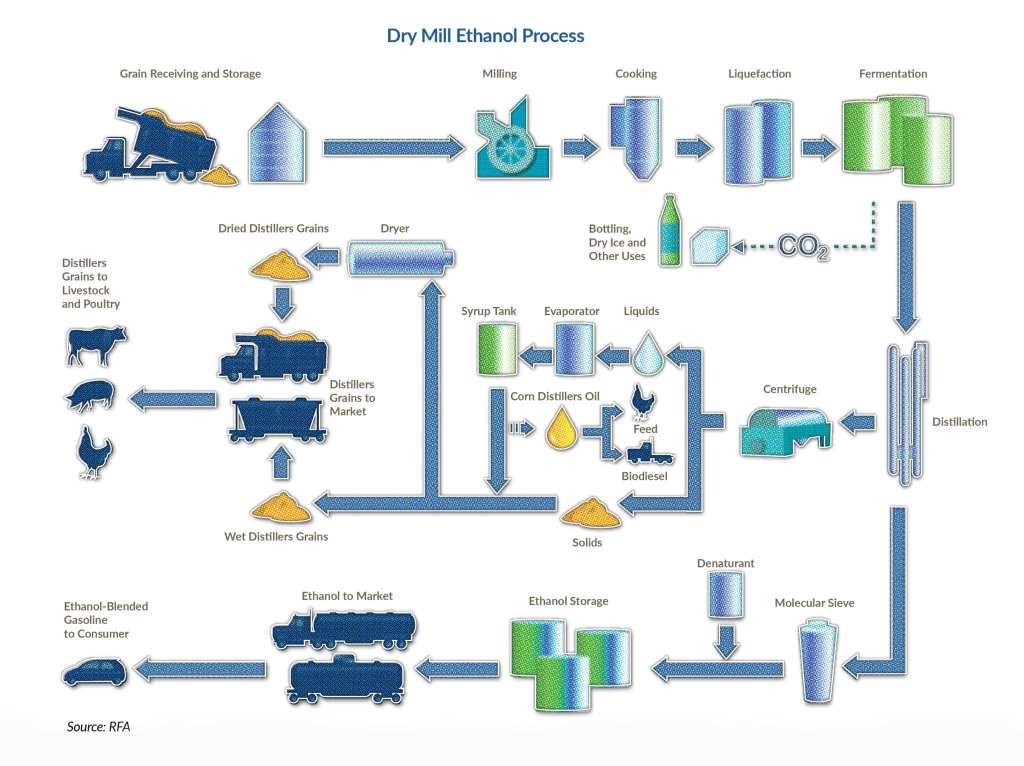
Now that we got the sugar from the herbaceous biomass, we could use it to make our desired biofuels or bioproducts. For this writing, we are going to use the process of fermentation as an example of how to get our desired biofuels and bioproducts from Herbaceous biomass. Fermentation is the process in which substances like sugar are chemically broken down by bacteria, yeasts, or other microorganisms. Let’s see the process of fermentation in producing ethanol. In ethanol fermentation, we add yeast to corn mash so that the corn mash could serve as a source of glucose. We also give is things like nutrients, oxygen, and proper PH and temperature. This produces ethanol and when the ethanol reaches a certain concentration, fermentation stops. Then the ethanol goes through a process called distillation, where the solution is heated to different temperatures to separate the ethanol. The first distillation yields us 55% ethanol and the second distillation yields us around 95% ethanol (statistic from Video Tour of an Ethanol Plant) Then the ethanol is pressurized through a molecular sieve where water is taken out from the ethanol. Now we finally have a biofuel. The image below is the process of this fermentation.
Now that we know we could make some products form the sugar in herbaceous biomass, we could explore some other products that could be made with these processes. For example, biodegradable plastic. These plastics could be degraded naturally with the help of things like natural bacteria and fungi. These plastics might seem like an obvious solution to plastic pollution but actually might not be as good as they sound. The reason is that some of these biodegradable bags don’t even degrade well and take a long time to decompose. This area is still in the research phase and could possibly be a solution to lower plastic pollution.
To sum up this blog post, lots of the products that we use every day are made from herbaceous biomass. For example, ethanol. But using these processes to make bioproducts like biodegradable bags might be a bright idea, in that it may help us solve some of our environmental problems, but still needs some more research.
Works cited:
Sugarcane Flowchart:
Ethanol Video:
Ethanol Flowchart:
Biodegradable bags:


